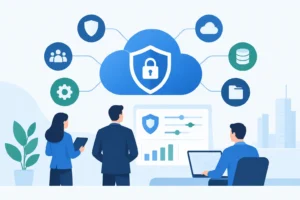
Growth usually exposes IT problems before it rewards strong sales. A company adds staff, opens a second location, adopts more cloud tools, and suddenly the network slows down, support tickets pile up, and basic security controls start falling behind. That is why outsourced IT support for growing companies has become a practical operating decision, not just a cost discussion.
For many small and mid-sized businesses, the issue is not whether technology matters. It is whether the business has the internal capacity to manage it well while still moving forward. Hiring a full in-house team can be expensive and slow. Relying on one overextended internal generalist often creates risk. Working with multiple vendors can leave gaps in accountability. A well-structured outsourced support model can solve those problems, but only when the fit is right.
Why growing businesses outgrow informal IT
In the early stage, many companies get by with a patchwork approach. One person handles user issues, a software vendor manages its own application, the internet provider gets called when connectivity drops, and outside consultants step in for larger projects. That setup can work for a while because the environment is still simple.
As the business grows, complexity compounds. More employees mean more devices, more permissions, more onboarding, and more security exposure. New offices or hybrid work create additional demands around connectivity, voice systems, wireless performance, and access control. Regulatory requirements may become more serious. Leadership starts asking for better reporting, stronger disaster recovery, and less downtime.
At that point, informal support stops being efficient. It becomes reactive. Problems are addressed after they interrupt work, not before. Technology decisions are made one project at a time, with no clear roadmap behind them. The result is usually the same: rising costs, uneven performance, and avoidable business risk.
What outsourced IT support for growing companies should actually deliver
The phrase can mean different things depending on the provider. Some firms offer little more than a help desk. Others bring strategic planning, infrastructure management, cybersecurity, cloud administration, vendor coordination, and project execution under one engagement.
For a growing business, outsourced support should do more than answer tickets. It should create a more stable operating environment. That means monitoring systems before issues become outages, maintaining hardware and software life cycles, protecting endpoints and accounts, supporting employees quickly, and aligning technology decisions with business growth.
It should also reduce management friction. Business leaders should not have to spend time chasing one vendor for internet issues, another for phones, and another for firewall changes. A strong partner takes ownership, coordinates across the stack, and gives the client one accountable point of contact.
The business case is not just lower cost
Cost matters, but it is rarely the whole reason companies outsource. The bigger value is often access to broader expertise without building a full internal department.
An internal hire may be capable and committed, but one person cannot specialize in every area. Security, cloud platforms, Microsoft 365 administration, backups, networking, compliance, procurement, and strategic planning all require different skill sets. Growing companies often need pieces of all of them before they can justify separate full-time roles.
Outsourcing can provide that depth in a more predictable model. Instead of hiring for every future need, the business gains access to a team that already has processes, tools, and coverage in place. That can improve response times, reduce downtime, and help leadership make better technology decisions earlier.
There is also a resilience advantage. Internal IT coverage can disappear when someone is on vacation, leaves the company, or is tied up on a project. A managed support partner gives continuity that is harder to maintain with a lean internal structure.
Where outsourced IT support works best
Outsourced IT support for growing companies tends to work well in a few common situations. One is the business that has grown past owner-led technology decisions but is not ready to build a large internal IT department. Another is the company with an internal IT manager who needs outside depth for security, infrastructure, and after-hours support. A third is the multi-site or operationally complex business that wants fewer vendors and clearer accountability.
It is also a strong fit for organizations that cannot afford prolonged downtime. If your phones, internet, cloud systems, or line-of-business applications go down and operations stop, reactive support is not enough. You need monitoring, escalation paths, backup planning, and a partner that understands business continuity as an operational requirement.
That said, full outsourcing is not always the answer. Some companies benefit more from a co-managed model, where an internal resource handles day-to-day business context and an outside provider supplies specialized support, tools, and project capacity. It depends on company size, internal talent, compliance demands, and how fast the business is changing.
How to evaluate an outsourced IT partner
The wrong provider can create as many problems as they solve. For growing businesses, the evaluation should go beyond price and basic service lists.
Start with scope. You need to know what the provider actually manages, what is considered project work, and where responsibility begins and ends. Ambiguity here often leads to frustration later. If cybersecurity, cloud administration, voice, physical security, or vendor coordination matter to your business, confirm those capabilities directly.
Next, look at responsiveness and ownership. Fast ticket response is useful, but it is not enough by itself. You want a partner that follows issues through to resolution, communicates clearly, and treats outages, recurring incidents, and security concerns with appropriate urgency.
Strategic value matters too. A provider should be able to help you plan hardware refreshes, support location growth, improve resilience, and identify operational risks before they become expensive failures. If the relationship never moves beyond password resets and printer issues, the business is not getting the full value of outsourced support.
Security deserves special attention. Growing companies are frequent targets because they often have meaningful data and revenue but less mature defenses than larger enterprises. Your IT partner should have a credible approach to endpoint protection, access controls, patching, backup integrity, incident response, and user risk reduction. If security is treated like an add-on instead of a core service responsibility, that is a concern.
Signs your current support model is holding growth back
Most companies do not decide to outsource because everything is running perfectly. The trigger is usually a pattern.
You may be seeing repeated outages, slow response on user issues, inconsistent onboarding for new hires, aging hardware with no refresh plan, or security tools that were purchased but never fully managed. Leadership may be spending too much time coordinating vendors. Internal staff may be burned out from handling technology problems on top of their primary jobs. Projects like office moves, cloud migrations, or security upgrades may keep slipping because no one has enough bandwidth to own them.
Those are not minor inconveniences. They are signs that IT has become a growth constraint. Once that happens, the cost of delay usually exceeds the cost of better support.
What a healthy outsourcing relationship looks like
A good outsourced IT relationship should feel structured, proactive, and calm. Employees know where to go for help. Leadership has visibility into risks and priorities. Systems are maintained on a schedule instead of in a panic. Security is part of day-to-day operations, not a once-a-year conversation.
The provider should also understand the business, not just the equipment. A manufacturer, professional services firm, healthcare practice, and multi-location office all have different uptime requirements, workflows, and risk profiles. The right partner adjusts service delivery to the way the business actually operates.
This is where a unified provider can make a meaningful difference. When managed IT, cybersecurity, connectivity, communications, and infrastructure support are aligned, there are fewer handoffs and fewer blind spots. For companies that are scaling, that kind of coordination often matters as much as technical skill. It creates consistency at the exact stage when complexity is increasing.
For businesses in Cleveland and across the Midwest, that often means looking for a partner with both technical depth and a service model built around accountability. Plasma Networks is one example of that approach, with support that spans the systems growing companies depend on every day.
Growth puts pressure on every weak point in a business, and IT is usually one of the first. The companies that handle that pressure well are not always the ones with the biggest internal teams. They are the ones that put the right support structure in place before instability becomes the cost of expansion.