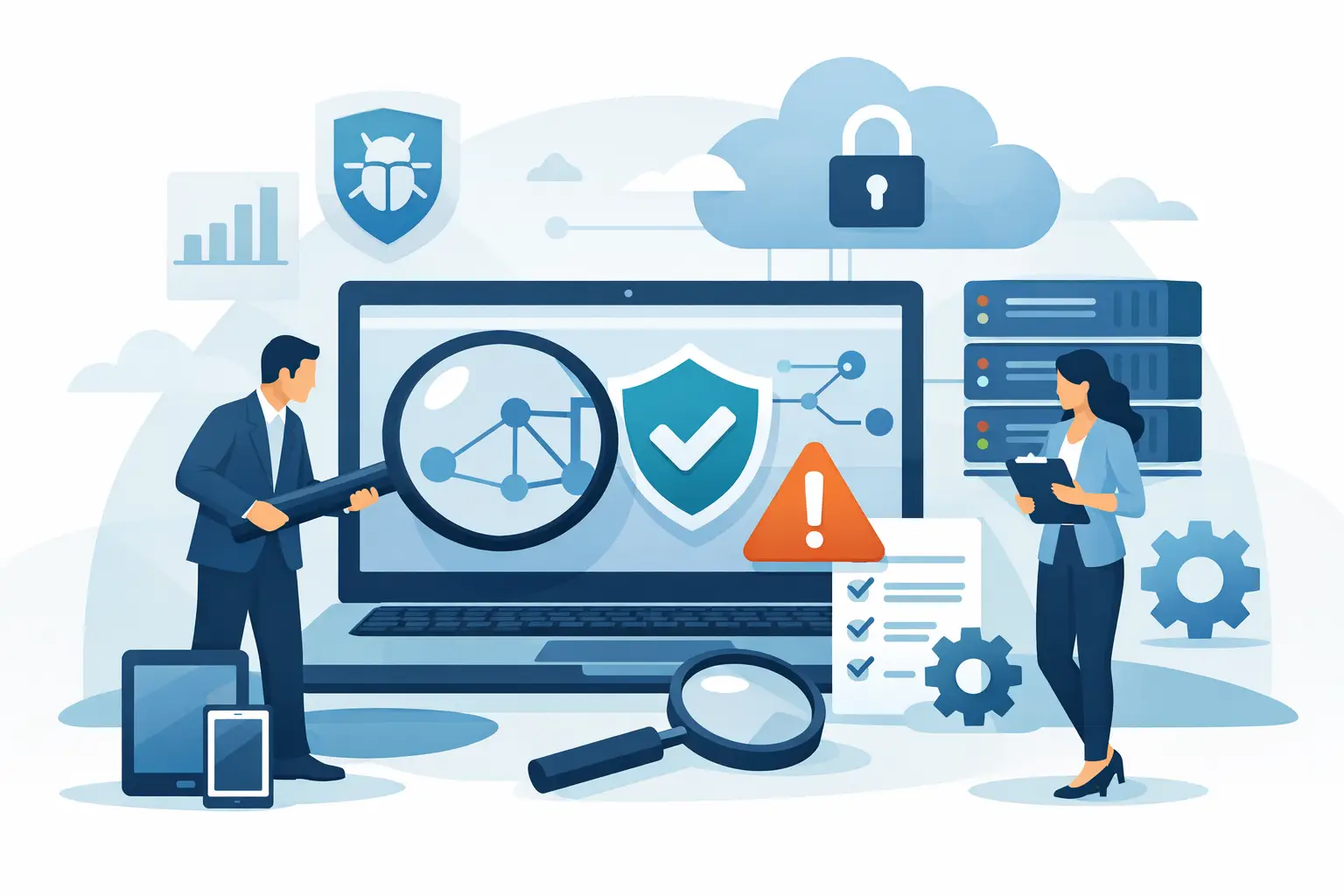
A technology risk audit usually starts after something goes wrong – a ransomware scare, a server outage, a failed backup, or a compliance question nobody can answer with confidence. That is exactly why leaders ask how to audit business technology risks before the next disruption, not after it. A good audit gives you a clear view of where your business is exposed, which issues matter most, and what needs attention first.
For small and mid-sized businesses, the challenge is rarely a total lack of technology. It is more often a patchwork of systems, vendors, workarounds, and aging equipment that grew over time. One office may have solid cybersecurity controls while another still relies on shared passwords. A company may have cloud applications in place but no formal backup validation. The risk is not just technical. It affects uptime, customer trust, insurance requirements, and day-to-day operations.
What a business technology risk audit should actually cover
When people hear the word audit, they often think of a checklist. Checklists help, but they are not the whole job. A technology risk audit should look at how your business depends on systems, where a failure would hurt most, and whether your current controls are realistic for the way your company operates.
That means reviewing core infrastructure such as networks, servers, cloud platforms, endpoints, and wireless access. It also means examining cybersecurity controls, access management, data protection, backup and recovery, physical security, vendor dependencies, communications systems, and support processes. If your phone system goes down and your team cannot reach customers, that is a business technology risk. If a former employee still has remote access, that is a business technology risk too.
A useful audit also separates inconvenience from true exposure. An outdated laptop may be annoying. An unpatched firewall, failed backup job, or internet connection with no redundancy can become an operational event very quickly.
How to audit business technology risks in a practical way
The strongest audits follow a simple sequence. They begin with business priorities, move into system review, then end with action. If you start with tools alone, you can collect a lot of data without getting answers leadership can use.
Start with business impact, not hardware
Before reviewing devices and software, identify the functions your business cannot afford to lose. For one company, that may be ERP access and warehouse connectivity. For another, it may be VoIP uptime, building access systems, and secure file sharing for a remote workforce.
Ask a few direct questions. Which systems stop revenue when they fail? Which applications contain sensitive customer or financial data? Which disruptions would affect compliance, safety, or contractual obligations? Which locations or departments are most dependent on stable connectivity?
This step matters because risk is contextual. A single internet circuit may be acceptable for a small administrative office. It is a very different decision for a production floor, medical practice, or multi-site operation where downtime has immediate cost.
Build an accurate technology inventory
You cannot audit what you do not know exists. Create a current inventory of hardware, software, cloud services, network equipment, security tools, user accounts, third-party platforms, and communication systems.
Most businesses uncover surprises here. Shadow IT is common. Teams sign up for cloud apps without formal review. Old devices remain connected long after replacement. Vendor-installed equipment is left unmanaged. A branch office may be using a consumer-grade router because nobody revisited the setup after a move.
Accuracy matters more than perfection. The goal is to establish a reliable baseline so risk decisions are based on facts rather than assumptions.
Review access and identity controls
Access risk is one of the most common weak points in growing organizations. Employees change roles, vendors receive temporary credentials, and shared logins remain in circulation because they seem convenient.
Audit who has access to what, how they authenticate, and whether permissions match current job responsibilities. Look closely at administrator accounts, remote access tools, Microsoft 365 or Google Workspace permissions, VPN access, and any system connected to financial or customer data.
Multi-factor authentication should be standard in most environments, but implementation details matter. If only part of the organization uses it, or if legacy accounts are exempt, your exposure remains. The same goes for offboarding. A strong process removes access promptly across every platform, not just email.
Evaluate security controls in real operating conditions
Security tools can create a false sense of confidence if nobody verifies that they are configured well and actively maintained. Antivirus alone is not a security strategy. Neither is owning a firewall without reviewing rules, firmware, alerts, and segmentation.
Look at endpoint protection, email security, patch management, vulnerability remediation, logging, alerting, DNS filtering, mobile device controls, and user security awareness practices. Then ask the harder question: if a threat gets through, how quickly would your team know, contain it, and recover?
This is where trade-offs show up. A smaller business may not need the same stack as a regulated enterprise, but it still needs layered protection that matches its risk profile. Spending more does not always mean better protection. Configuration, monitoring, and response discipline often matter more than the number of tools in place.
Backup, recovery, and downtime planning are part of the audit
Many organizations believe they are protected because backups exist. A risk audit tests that assumption. Are backups completing successfully? Are they monitored? Are recovery points acceptable for the business? Has anyone actually restored critical systems or data recently?
A backup that cannot be restored during an incident is not protection. The same principle applies to continuity planning. If your primary internet connection fails, what happens next? If your cloud file platform has an outage, do teams have an alternate process? If a site loses power, can the business continue elsewhere?
The audit should review not just backup software, but actual recovery readiness. Recovery time objectives and recovery point objectives should reflect operational reality. If leadership expects systems back in two hours but recovery would take two days, that gap needs to be visible.
Include vendors, physical security, and communications
Technology risk extends beyond the server room. Third-party vendors often hold access to data, infrastructure, cameras, phone systems, and line-of-business applications. If those relationships are loosely managed, they create blind spots.
Review who your vendors are, what they can access, how they are authenticated, and whether responsibilities are clearly documented. If multiple providers handle internet, phones, security systems, cloud tools, and support, ownership can become fragmented during an outage.
Physical security belongs in the same conversation. Network closets left unlocked, unmanaged cameras, insecure visitor access, and poorly controlled badge systems can create both cyber and operational exposure. The same goes for communications. A phone outage, failed conference system, or unsupported messaging platform may not sound like a security problem, but it can still disrupt service and revenue.
Score risks by likelihood and business impact
Once findings are collected, prioritize them. Not every issue deserves the same urgency. The right question is not whether something is imperfect. It is whether the weakness is likely to cause harm and how severe that harm would be.
A simple scoring model works well. Rate each issue by likelihood, business impact, and ease of remediation. This helps distinguish between a medium-priority housekeeping item and a high-priority exposure that threatens uptime or data security.
For example, unsupported operating systems, weak remote access controls, failed backup testing, and single points of network failure usually rise to the top because the consequences are immediate and expensive. Cosmetic configuration issues usually do not.
Turn the audit into an action plan
An audit has value only if it leads to decisions. The final output should not be a dense technical document that sits unread. It should give leadership a clear path forward with prioritized fixes, budget implications, ownership, and realistic timelines.
Some issues can be resolved quickly, such as tightening permissions, enabling missing multi-factor authentication, removing stale accounts, or correcting backup alerts. Others require a broader roadmap, such as replacing aging infrastructure, adding internet redundancy, consolidating vendors, or modernizing endpoint management.
This is also where outside support can make a measurable difference. If your internal team is stretched thin or your environment spans networking, cybersecurity, communications, cloud platforms, and physical security, a partner with broad operational depth can help close gaps faster and with less disruption. That is often where companies benefit from working with a provider like Plasma Networks that can evaluate the full environment instead of treating each issue in isolation.
Common mistakes that weaken technology risk audits
The biggest mistake is treating the audit as a one-time event. Risks change as your business grows, adds locations, adopts cloud services, or takes on new compliance obligations. Annual reviews are a good baseline, but major operational changes should trigger a fresh look.
Another common problem is focusing only on cybersecurity while ignoring resilience. Security matters, but so do uptime, carrier dependencies, hardware lifecycle, support coverage, and recovery planning. A business can be well-defended and still be vulnerable to operational failure.
Finally, avoid audits that produce only technical findings with no business context. Executives need to understand what the issue means in terms of downtime, financial exposure, customer impact, and recovery risk. That is what turns a list of problems into a management decision.
A strong technology risk audit does not need to be dramatic. It needs to be honest, thorough, and tied to how your business actually runs. When you know which systems matter most, where the weak points are, and how recovery would work under pressure, you can make better decisions before small issues turn into costly interruptions.