When a business is dealing with slow file transfers, choppy video calls, or recurring outages, the question of fiber internet vs cable internet stops being theoretical. It becomes an operational decision that affects productivity, customer experience, and risk. For growing organizations, the right connection is not just about advertised download speeds. It is about how reliably the network supports daily work, cloud applications, security tools, and future growth.
For many small and mid-sized businesses, both options can look similar at first glance. Each can provide high-speed internet, support modern business applications, and serve as the backbone for phones, cloud platforms, and collaboration tools. The difference shows up in performance consistency, upload capacity, resilience, and how much strain the connection can handle as the business becomes more connected.
Fiber internet vs cable internet: the core difference
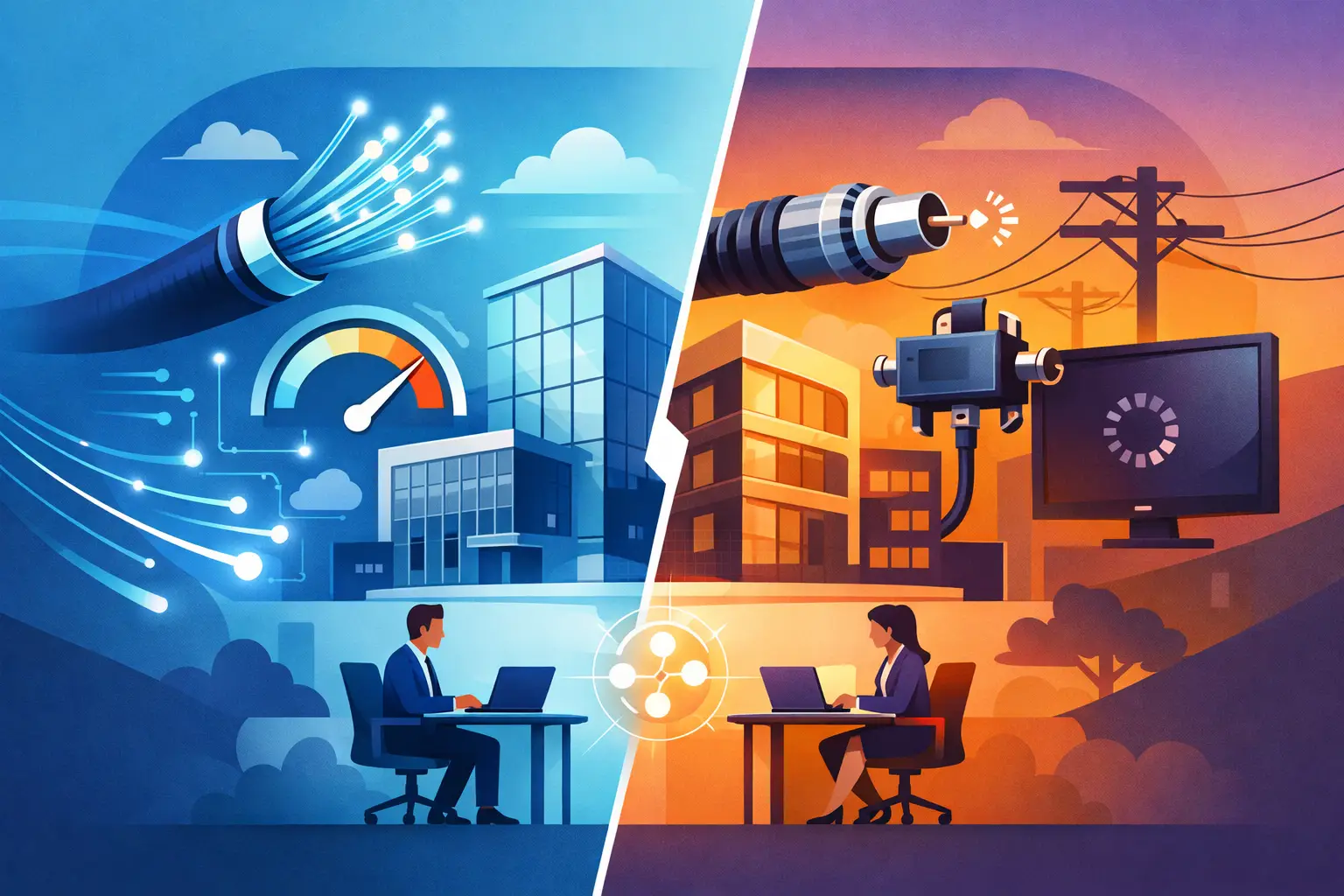
Fiber internet uses fiber-optic lines to transmit data as light. Cable internet uses coaxial cable infrastructure, often shared across a neighborhood or local service area. That technical distinction matters because it shapes speed, latency, reliability, and how your internet performs during peak usage times.
In practical terms, fiber is typically the stronger option for businesses that rely heavily on cloud systems, large file uploads, hosted voice, video conferencing, and multiple users working at once. Cable can still be a reasonable fit for smaller offices with lighter internet demands and tighter budgets, especially where fiber is not yet available.
The best choice depends on how your business operates, what downtime costs you, and how much performance headroom you need.
Speed is not just a download number
Many business leaders compare internet services by looking at the top advertised speed. That is understandable, but it only tells part of the story.
Fiber usually offers symmetrical speeds, which means upload and download performance are similar. If your team uses cloud backup, sends large design files, hosts meetings on Teams or Zoom, or depends on VoIP calling, upload speed matters just as much as download speed. A connection with fast downloads but limited uploads can create bottlenecks that are hard to diagnose and frustrating to live with.
Cable internet often delivers strong download speeds, but upload capacity is usually much lower. For a business that mainly browses the web, uses email, and runs a few standard SaaS tools, that may be acceptable. For a company moving data constantly between users, locations, and cloud platforms, those upload limits can quickly become a problem.
This is why a 500 Mbps cable circuit and a 500 Mbps fiber circuit do not always feel the same in day-to-day business use. The experience can be very different once real workloads are involved.
Reliability and uptime matter more than peak performance
A fast connection is valuable only when it is consistently available. For business environments, reliability is often the deciding factor.
Fiber generally provides more stable performance and lower latency. It is less susceptible to the slowdowns that can happen on shared cable networks, particularly during busy periods. That consistency supports voice traffic, remote access, cloud applications, and other systems that need predictable connectivity.
Cable can perform well, but because bandwidth is often shared, users may notice fluctuations during high-demand periods. In some locations, that may be minor. In others, it can affect meeting quality, application responsiveness, and the overall user experience.
If your organization supports customer service teams, multi-site operations, security monitoring, or time-sensitive transactions, even short disruptions can have a measurable cost. Lost productivity, missed calls, delayed orders, and interrupted workflows add up quickly.
Latency affects more than video calls
Latency is the delay between sending and receiving data. It does not get the same attention as speed, but it has a direct impact on responsiveness.
Fiber usually offers lower latency than cable. That can improve the performance of cloud platforms, virtual desktops, voice systems, video conferencing, and remote support tools. Users notice it when applications open faster, conversations sound cleaner, and systems respond without lag.
Cable may still support these tools, but under heavier usage or in busier service areas, latency can rise. For businesses with hybrid teams, hosted phone systems, or real-time applications, that difference is worth taking seriously.
Scalability is where fiber often pulls ahead
Many companies choose internet service based on current needs, then outgrow it faster than expected. A business adds employees, adopts more cloud services, installs security cameras, supports remote workers, or brings in new software platforms. Suddenly, the connection that once seemed sufficient becomes a constraint.
Fiber is typically better positioned for growth. It can support higher bandwidth demands, heavier upload activity, and more connected devices without the same level of performance trade-offs. That makes it a strong fit for organizations planning expansion, digital transformation, or more distributed operations.
Cable can still serve as a practical option for smaller offices or branch locations, particularly when cost sensitivity is high and usage patterns are predictable. But if your business is moving toward cloud-first systems or greater operational complexity, cable may become a short-term answer rather than a long-term one.
Cost should be measured against business impact
Cable internet is often less expensive upfront, which is one reason it remains common in the small business market. If the budget is tight and the workload is modest, cable may offer acceptable value.
Fiber usually comes at a higher monthly cost, especially for dedicated business-grade service. But the pricing conversation should go beyond the bill itself. A lower-cost connection that introduces slowdowns, failed calls, or downtime can become more expensive than it appears.
The better question is not just, “Which service costs less?” It is, “Which service supports the business with fewer interruptions, less risk, and more room to grow?”
That shift in thinking is especially important for organizations where internet performance touches revenue, client communication, operations, or compliance.
Fiber internet vs cable internet for different business types
A small administrative office with limited staff, light cloud usage, and minimal upload demand may do just fine with cable internet. If availability is good and service levels are consistent, cable can be a practical and cost-conscious choice.
A professional services firm, medical office, manufacturer, logistics company, or multi-location business will often benefit more from fiber. These environments tend to depend on stable connectivity for phones, cloud applications, shared files, security systems, and business continuity. In those cases, stronger performance and higher reliability are not luxuries. They are operational requirements.
There is also a middle ground. Some businesses use fiber as the primary connection and cable as a secondary failover circuit. That approach improves resilience and reduces the risk of a single outage bringing operations to a stop. For companies that cannot afford internet downtime, redundancy deserves a place in the conversation.
What to ask before you choose
Before selecting a service, it helps to look at how your business actually uses the network. How many users are active at once? How much of your workflow depends on cloud platforms? Are you uploading large files, supporting remote access, or using hosted voice systems? What does one hour of downtime cost your team?
It is also worth asking whether the provider offers business-grade support, service level commitments, and room to scale. The underlying connection matters, but so does the quality of support behind it. When there is a problem, response time and accountability matter just as much as bandwidth.
For many organizations, internet should be evaluated as part of a broader IT strategy rather than as a standalone utility. Connectivity affects cybersecurity, communications, cloud performance, and end-user productivity. That is why businesses often benefit from working with a partner that can look at the full environment instead of just quoting a circuit.
At Plasma Networks, that is often where the conversation starts – not with a generic speed recommendation, but with how the business runs and what the network needs to protect.
Which one is better?
If the question is simply which technology is stronger overall, fiber usually wins. It delivers better upload speeds, lower latency, stronger consistency, and better long-term scalability. For many business environments, those advantages justify the investment.
But better technology does not always mean the only right answer. Cable remains a workable option for businesses with lighter demands, limited budgets, or locations where fiber access is still developing. The right decision comes down to usage patterns, growth plans, and your tolerance for performance variability.
A business connection should do more than get users online. It should support the way your organization works today and give you confidence in what comes next. If your internet is becoming a point of friction, that is usually a sign the decision deserves a closer look.