A file gets flagged on a workstation at 9:12 a.m. Antivirus quarantines it, logs the event, and moves on. By 11:30, the attacker has already used stolen credentials to access email, move laterally, and start probing file shares. That gap is where the real MDR vs antivirus protection conversation starts.
For many businesses, antivirus is familiar, affordable, and easy to understand. It looks for known malicious files and suspicious behavior on an endpoint, then tries to block or remove the threat. MDR, or Managed Detection and Response, is a broader security service that combines monitoring, investigation, threat detection, and human-led response. Both matter, but they are not interchangeable.
If you are deciding how to protect your business, the right question is not which one sounds more advanced. It is which approach matches your risk, your internal IT capacity, and the speed at which you need incidents contained.
MDR vs antivirus protection: what is the real difference?
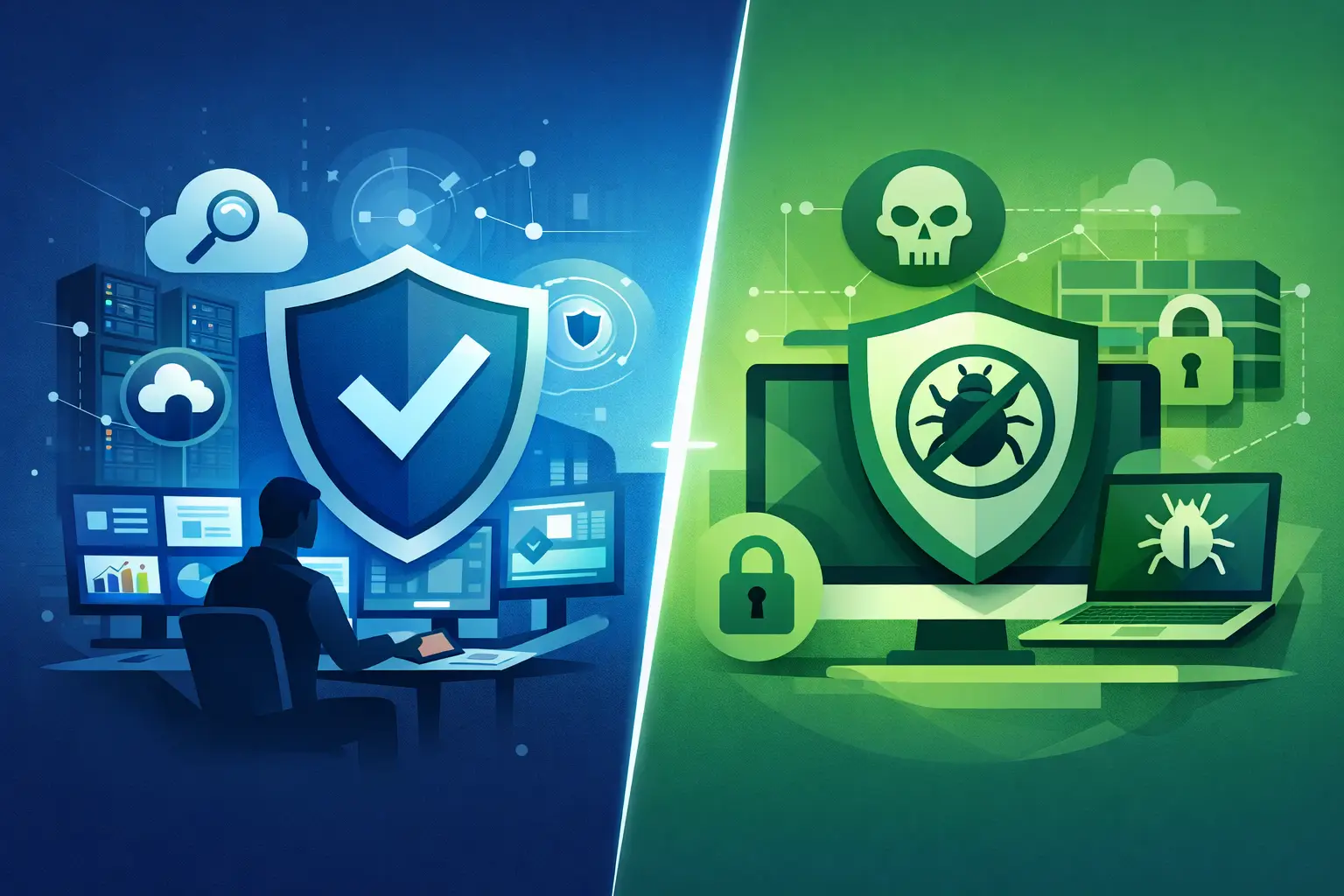
Antivirus is a tool. MDR is a service.
That distinction shapes everything that follows. Traditional antivirus focuses on prevention at the device level. It scans files, monitors for known malware signatures, and may use behavioral analysis to catch suspicious activity. Modern endpoint protection platforms have improved a great deal, but the core mission is still to stop malicious code from running.
MDR looks at a wider picture. It typically includes endpoint telemetry, alert analysis, threat hunting, investigation, and active response by security professionals. Instead of just saying, “This file looks bad,” MDR asks, “What is happening across the environment, how serious is it, and what should be done right now?”
For a small or mid-sized business, that difference is practical, not theoretical. Antivirus may tell you something was blocked. MDR is designed to tell you whether the event is part of a larger attack, whether other systems are affected, and whether someone needs to isolate devices, disable accounts, or escalate the issue before downtime spreads.
What antivirus does well
Antivirus still has a role in business security. It is often the first control standing between a user and a malicious attachment, infected download, or known ransomware strain. It is relatively cost-effective, widely available, and simple to deploy across laptops, desktops, and servers.
For businesses with basic security needs, antivirus can reduce exposure to common threats. It works best against known malware and routine attack patterns. It can also satisfy a baseline requirement for endpoint protection in many IT environments.
The limitation is that antivirus is not a security operations function. It does not replace monitoring. It does not investigate context well on its own. And it does not make strategic decisions during an active incident.
That matters because many modern attacks do not depend on obviously malicious files. Attackers increasingly use stolen credentials, legitimate administrative tools, remote access utilities, and scripted behavior that can blend into normal activity. In those cases, antivirus may see very little to stop.
Where antivirus alone falls short
The biggest weakness of antivirus-only protection is not that it fails all the time. It is that it can leave businesses exposed to what happens after initial access.
An attacker does not always need malware to cause damage. If a user account is compromised through phishing, the adversary may sign in through a valid channel, access cloud applications, and move through the environment using approved tools. Antivirus on an endpoint may never raise a meaningful alert.
Even when antivirus does detect something, alert fatigue becomes a problem. Internal IT teams are often already balancing vendor management, user support, infrastructure maintenance, patching, procurement, and project work. If security alerts are just one more item in a crowded queue, response time suffers.
That delay is expensive. A threat that lingers for hours can become a business continuity issue. It can affect operations, customer trust, compliance standing, and recovery costs. For organizations without a dedicated security team, antivirus often answers the question, “Was something suspicious found?” but not, “What do we do next, and how fast can we contain it?”
What MDR adds to the equation
MDR is built for detection and response, not just prevention. That usually means continuous monitoring by security analysts, deeper visibility into endpoint behavior, and a response process that goes beyond sending an alert to an inbox.
A strong MDR service correlates signals across systems, separates noise from real threats, and investigates suspicious patterns that would otherwise be missed. If a login anomaly, PowerShell execution, unusual data movement, and privilege escalation happen close together, MDR is designed to connect those dots.
This is where MDR vs antivirus protection becomes especially relevant for growing businesses. As your environment expands across cloud platforms, remote users, mobile endpoints, line-of-business applications, and third-party integrations, attack paths become more complex. Security tools generate more data, but more data does not automatically mean better protection. Someone still needs to interpret it and act on it.
MDR helps close that gap. Depending on the provider, response actions may include isolating endpoints, disabling compromised accounts, removing persistence mechanisms, and advising internal stakeholders on next steps. The service brings human judgment into the loop, which is often what turns raw alerts into real risk reduction.
Which option makes sense for small and mid-sized businesses?
It depends on your risk profile and your internal resources.
If your organization is very small, handles limited sensitive data, and has a simple environment, antivirus may be enough as part of a basic security stack, especially when paired with patching, backups, email security, and access controls. But that setup assumes your exposure is modest and your tolerance for detection gaps is relatively high.
For many small to mid-sized businesses, that assumption no longer holds. Hybrid work, compliance pressure, cyber insurance requirements, and rising ransomware activity have changed the baseline. A manufacturer, healthcare practice, law firm, logistics company, or multi-location business may not think of itself as a high-value target, but attackers often focus on organizations that are easier to disrupt and less prepared to respond.
That is why MDR is often the better fit once operations become more dependent on uptime, customer data, and uninterrupted access to systems. If an hour of downtime affects revenue, service delivery, or client confidence, faster detection and response become operational priorities, not just IT preferences.
MDR vs antivirus protection in a layered security strategy
The best decision is rarely antivirus or MDR by itself. In most business environments, it is antivirus and MDR as part of a layered defense.
Antivirus remains useful at the endpoint. It can block known threats quickly and reduce the number of incidents that move further into the environment. MDR builds on that foundation by providing oversight, analysis, and action when threats are more subtle or more serious.
Think of antivirus as one control in the stack. MDR helps coordinate what happens when that control is bypassed, misconfigured, or facing a threat it was never designed to handle alone. That layered model is stronger because it acknowledges a reality most business leaders already understand: no single tool prevents every problem.
This is also where working with an experienced IT and security partner can make a measurable difference. Businesses do not just need software deployed. They need policies aligned, alerts tuned, users supported, and incidents handled with precision. Plasma Networks approaches security that way because protection is only valuable if it supports continuity and keeps the business moving.
Questions to ask before you choose
Before selecting a security approach, it helps to ask a few direct questions. If antivirus raises an alert at 2:00 a.m., who is reviewing it? If a user account is compromised but no malware is involved, how will you know? If an endpoint needs to be isolated immediately, who has the authority and process to do it? And if a regulator, insurer, or customer asks how threats are monitored and contained, what is your answer?
Those questions usually clarify the gap. Many businesses already have endpoint tools in place. What they do not have is consistent visibility, triage, and response capacity.
That is the real business case for MDR. It is not about buying a more sophisticated label. It is about reducing the time between detection and containment so a security event does not become an operational event.
Security decisions are easier when they are tied to business outcomes. If your priority is simply checking a box for endpoint protection, antivirus may cover the minimum. If your priority is protecting uptime, limiting damage, and having experts actively watch for threats, MDR earns serious attention. The right next step is the one that leaves your team with fewer blind spots and more confidence when something goes wrong.