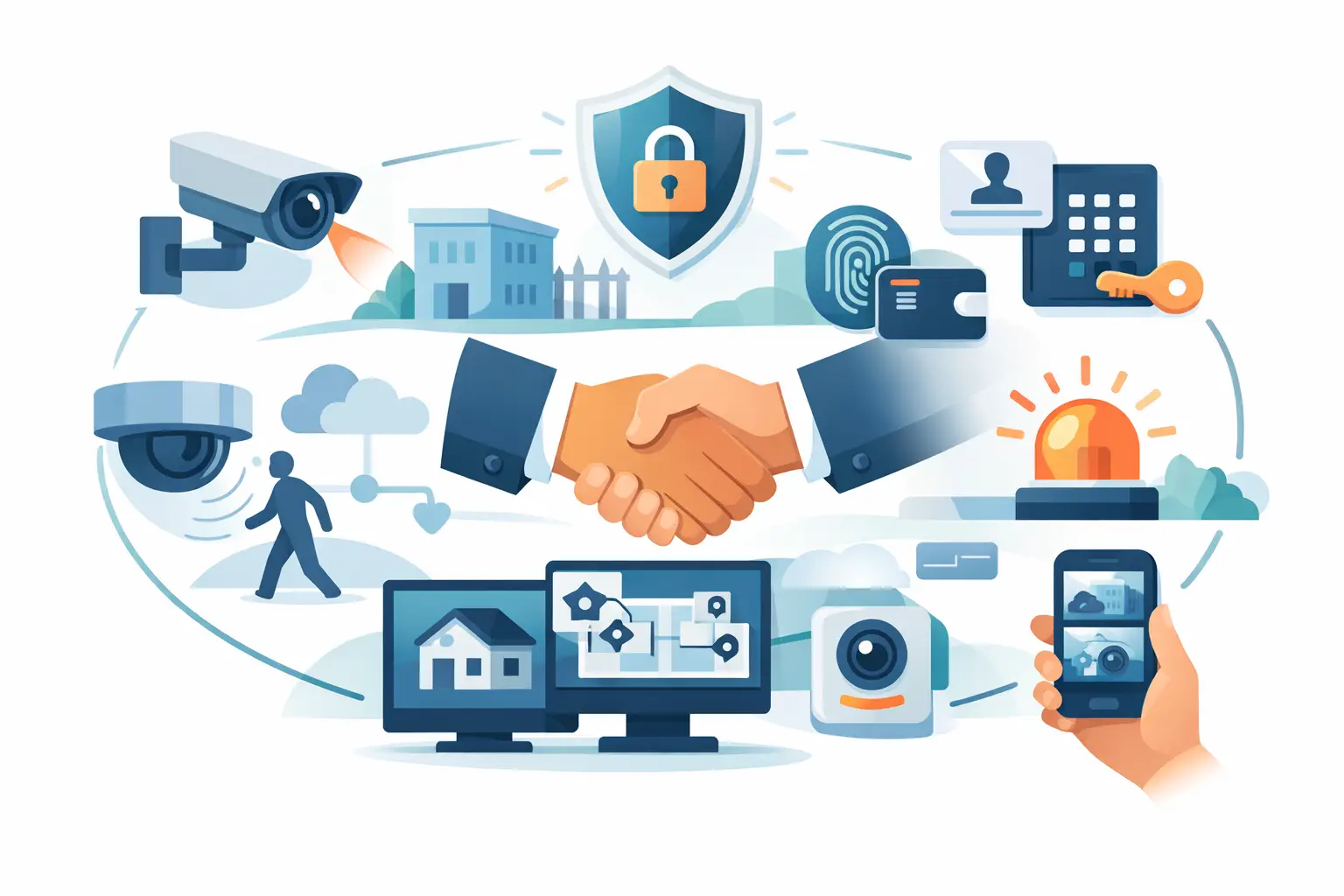
A door forced open after hours should not leave your team checking three different systems, calling two vendors, and guessing what happened. For many businesses, that is still the reality. The real value in physical security integration benefits comes from turning separate tools – access control, video surveillance, alarms, intercoms, and network infrastructure – into one coordinated security environment that supports faster decisions and fewer gaps.
For small and mid-sized organizations, the issue is rarely a total lack of security technology. It is fragmentation. One system records video, another manages credentials, another sends alerts, and none of them tell the full story on their own. That creates delay, extra labor, and avoidable risk. Integration changes that by connecting systems so they work together instead of competing for attention.
What physical security integration benefits really mean
Physical security integration is the process of connecting your security systems so events, permissions, alerts, and data can be managed in context. Instead of reviewing footage in one application and badge activity in another, your team can see who entered, when they entered, what the cameras captured, and whether an alarm condition was triggered at the same time.
That sounds straightforward, but the business impact is significant. Integrated systems improve response times, reduce manual work, and make security operations more consistent. They also create a stronger bridge between physical security and IT, which matters more now that cameras, door controllers, and remote access tools all depend on the same network and security standards.
1. Faster response when incidents happen
Speed matters during a security event. If a door alarm goes off, an integrated system can immediately pull up the associated camera view, show recent access activity, and alert the right people. Your team is not wasting time moving between disconnected dashboards or trying to confirm whether the alert is real.
That faster response can reduce damage, shorten investigations, and help your staff act with more confidence. For an office, warehouse, clinic, or multi-site operation, minutes matter. In some cases, seconds matter.
This is one of the clearest physical security integration benefits because it affects daily operations, not just worst-case scenarios. Even routine issues like failed badge reads, propped doors, or visitor access problems become easier to resolve when the systems involved are tied together.
2. Better visibility across locations and systems
Many growing businesses add security technology one site at a time. A new office gets one platform. A warehouse expansion gets another. Over time, leadership ends up with inconsistent reporting and limited oversight.
Integrated security gives decision-makers a more complete view across locations. A central dashboard can show access events, camera health, alarm status, and user activity across the organization. That is useful for IT managers and operations leaders who need consistency without building a large in-house security team.
There is a practical benefit here beyond convenience. Better visibility helps organizations spot patterns they would otherwise miss, such as repeated after-hours access attempts, doors that are regularly left unsecured, or cameras that are offline more often than expected. Those patterns often point to larger operational problems.
3. Simpler management for staff and administrators
When systems are disconnected, administration becomes repetitive. A terminated employee may need to be removed from the access control system, visitor log, parking credential list, and related communications process separately. That creates room for mistakes.
Integration simplifies this work. User permissions can be managed more consistently, and changes can happen faster. If your security platform is also aligned with IT workflows, employee onboarding and offboarding become more controlled. That is especially valuable for organizations dealing with frequent staffing changes, contractors, or multiple levels of facility access.
Simpler management also reduces the burden on office managers and IT teams. They are no longer acting as the human connection between systems that should already be talking to each other.
4. Stronger security with fewer blind spots
One of the biggest risks in any environment is the gap between systems. A camera may capture an event, but no one reviews it because there was no corresponding alert. An unauthorized person may enter using a borrowed badge, but there is no simple way to compare the credential event with video. These are the kinds of blind spots that lead to missed incidents.
Integrated environments reduce those gaps. Events can trigger cross-system actions, such as locking designated doors, flagging unusual access attempts, or attaching video clips to alarm notifications. The result is a more coordinated defense that gives staff better information when something is off.
That does not mean integration solves every security problem on its own. System design still matters. Camera placement, credential policies, network segmentation, and user training all affect outcomes. But integration gives those pieces a better chance to work as part of a larger strategy.
5. Better support for compliance and investigations
For organizations in healthcare, finance, manufacturing, education, or any regulated environment, documentation matters. You need reliable records of who accessed restricted areas, when events occurred, and how incidents were handled.
Integrated systems can improve audit readiness by bringing together logs, video evidence, alarm history, and access records in one place. That makes it easier to produce documentation during internal reviews, insurance claims, or formal investigations.
It also improves the quality of investigations. Instead of pulling reports from multiple platforms and trying to align timestamps manually, your team can work from a more complete incident timeline. That saves time, but more importantly, it improves accuracy.
There is an important trade-off to consider here. Better data is only useful if retention policies, storage capacity, and permissions are configured correctly. Businesses should think through how long records need to be stored, who can access them, and how evidence is protected.
6. Lower operational friction and vendor complexity
A common frustration for business leaders is not just managing security tools. It is managing the companies behind them. One vendor handles cameras, another handles access control, another handles networking, and when something fails, each points somewhere else.
Integration can reduce that friction by creating a more coordinated environment and, when handled by the right partner, clearer accountability. Fewer handoff points usually mean faster troubleshooting and less time spent chasing answers.
This matters because physical security is no longer isolated from the rest of the technology stack. If a camera is dropping offline, the issue could involve switching, cabling, bandwidth, power, or the application itself. A business that treats these as unrelated systems often ends up with slower resolution and more downtime.
For companies that want one accountable technology partner, this is where the model becomes especially valuable. Providers like Plasma Networks can bridge physical security and IT operations in a way that reduces finger-pointing and improves long-term system performance.
7. More scalable growth as the business changes
Security decisions made during one phase of growth often create problems later. A standalone system may be affordable for one location, but difficult to expand. A mix of aging tools may work today, but become harder to support as the company adds sites, staff, or compliance requirements.
Integrated security creates a stronger foundation for growth. New doors, cameras, users, and locations can be added with more consistency. Reporting stays more uniform. Administration stays more manageable. That is important for businesses that are expanding operations but do not want to rebuild their security approach every two years.
Of course, scalability depends on choosing the right platforms from the beginning. Some systems claim open integration but offer limited compatibility in practice. Others become expensive as licensing grows. A good design should account for where the business is headed, not just what it needs this quarter.
8. A better connection between physical security and cybersecurity
This may be the most overlooked benefit. Modern physical security systems run on your network, store data, use credentials, and often support remote access. That means they are part of your broader risk profile.
When physical security is integrated with sound IT and cybersecurity practices, businesses gain more than convenience. They get stronger control over device management, user access, patching, segmentation, and monitoring. That reduces the chance that a neglected camera, controller, or unmanaged device becomes a weak point in the environment.
This is also where business continuity improves. If security systems are designed with network resilience, backup power, secure remote access, and ongoing support in mind, they are more likely to perform when you need them most.
When integration makes the most sense
Not every organization needs a large, highly customized platform. For some small offices, a simpler setup may be enough. But integration becomes especially valuable when you have multiple entry points, multiple locations, compliance requirements, a mix of employees and contractors, or limited internal IT capacity.
It also makes sense when your current systems create daily friction. If investigations take too long, reports are hard to generate, user changes are inconsistent, or your teams rely on workarounds, those are signs the environment is ready for a more connected approach.
The goal is not integration for its own sake. The goal is a security environment that is easier to manage, quicker to respond, and better aligned with the way your business actually operates.
The best security systems do more than record problems after the fact. They help your people see clearly, act quickly, and keep the business moving with fewer interruptions.