A phone system usually gets attention only when it starts causing problems – dropped calls, limited features, rising maintenance costs, or an office move that suddenly turns a simple change into a project. That is why the voip vs pbx question matters. For most businesses, this decision is not just about phones. It affects uptime, customer experience, internal responsiveness, and how easily your communications can grow with the rest of your technology.
If you are evaluating options for a small to mid-sized business, it helps to separate the labels from the real issue. You are choosing between different ways to manage voice communications, support your team, and control risk over time. The right answer depends on your infrastructure, your budget, and how much flexibility your organization needs.
Understanding VoIP vs PBX
At a basic level, PBX stands for private branch exchange. It is the system that manages internal and external business phone calls. Traditionally, a PBX system has been installed on-site with physical hardware connected to desk phones and phone lines. Many businesses still use this model, especially if they built their communications environment years ago and need a predictable, familiar setup.
VoIP stands for voice over internet protocol. Instead of relying primarily on traditional phone lines, VoIP sends voice traffic over your internet connection. That changes more than the transport method. It often changes the entire operating model, from how users are added to how features are managed to how offices handle remote and hybrid work.
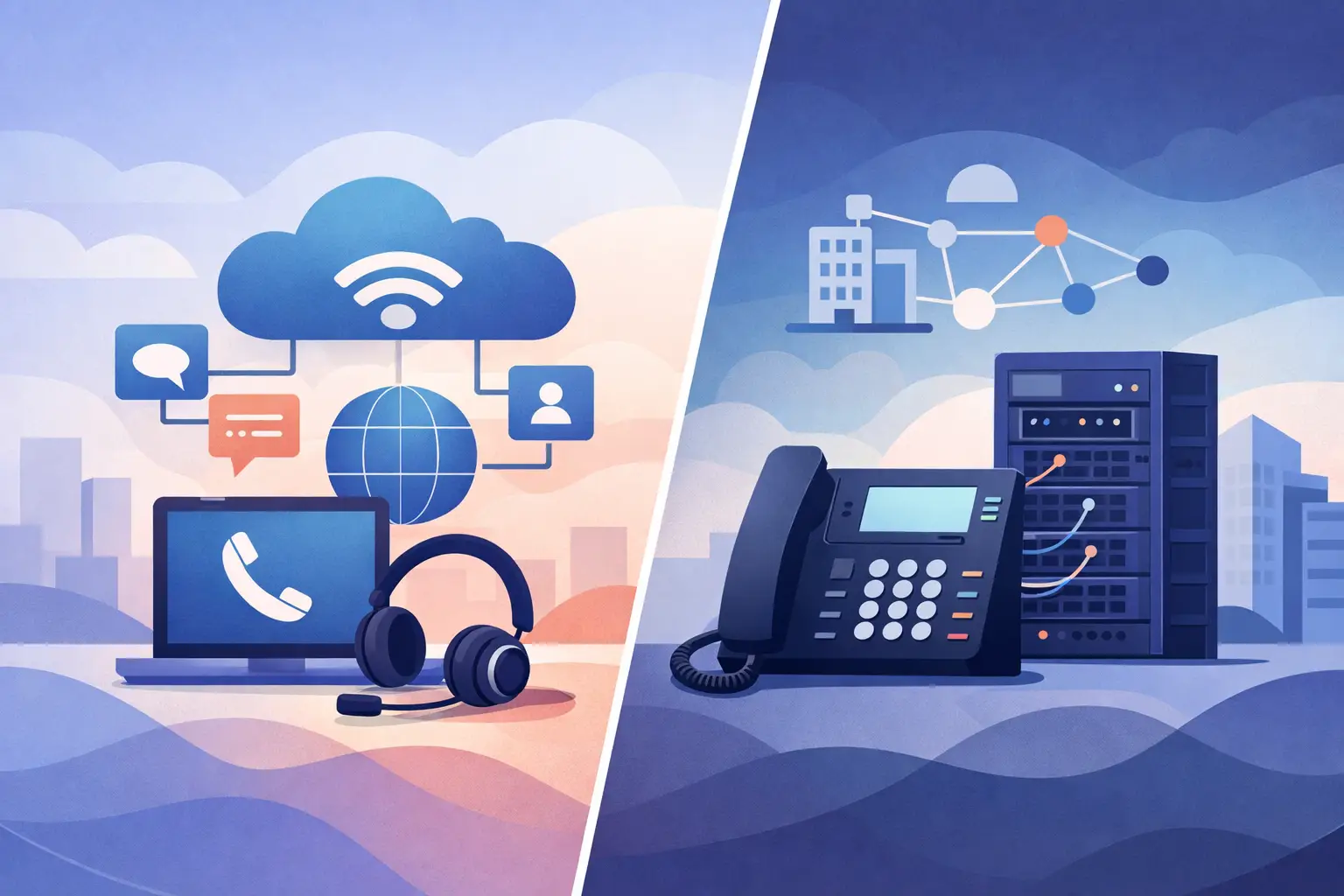
One point often gets missed in the voip vs pbx conversation: these are not always direct opposites. A PBX can be traditional and on-premises, but there are also IP-PBX systems that use internet-based technology while still keeping more control on-site. In practice, though, most businesses comparing the two are deciding between a legacy or on-premises PBX approach and a hosted or cloud-based VoIP platform.
Where PBX Still Makes Sense
A traditional PBX can still be a good fit in the right environment. If your organization already owns functional equipment, has stable call patterns, and does not expect major changes in staffing or locations, keeping a PBX may be financially reasonable in the short term. Some companies also prefer local control over hardware, especially in facilities with specialized workflows, legacy integrations, or strict operational requirements.
PBX systems can deliver reliable internal calling and, when properly maintained, consistent voice performance. For organizations with strong in-house IT resources and minimal need for mobility, an on-site system may feel straightforward. The infrastructure is physically present, your team knows where it lives, and there is a certain comfort in that visibility.
The trade-off is that comfort often comes with maintenance overhead. Hardware ages. Manufacturer support eventually ends. Moves, adds, and changes can become slower and more expensive than they should be. If your business opens another location, shifts to hybrid work, or wants more advanced call routing, reporting, or application integration, a traditional PBX can start to feel restrictive.
Why Many Businesses Move to VoIP
VoIP is often attractive because it aligns better with how modern businesses operate. Teams work across offices, homes, and mobile devices. Companies need to add users quickly, support growth without major hardware investments, and keep communications tied to the rest of the business.
A cloud-based VoIP platform typically makes that easier. New users can often be provisioned faster. Features like auto attendants, voicemail to email, call forwarding, softphones, mobile apps, and call analytics are more accessible. That means your phone system stops being a fixed office utility and starts acting more like a flexible business platform.
For growing organizations, scalability is one of the biggest advantages. Expanding a traditional PBX can involve new cards, licensing, cabling, or carrier changes. With VoIP, scaling usually follows your subscription and network capacity. That is simpler to budget for and easier to adjust when business conditions change.
There is also the matter of location independence. If weather, travel, staffing changes, or facility issues disrupt access to the office, a VoIP system can help maintain continuity. Calls can be routed to mobile devices, alternate users, or other sites without the same physical constraints of an office-bound setup.
Cost Is Important, But It Is Not Simple
Many businesses begin with cost, and that is fair. But comparing voip vs pbx on price alone can be misleading.
A traditional PBX often involves a larger upfront capital expense. You purchase hardware, install the system, and then pay for maintenance, carrier services, and eventual upgrades or replacements. If the system is already in place, the monthly costs may seem manageable, which is why some organizations delay change longer than they should.
VoIP usually shifts the model toward operational expense. Instead of large hardware purchases, you pay recurring monthly fees per user or per service bundle. For some businesses, that creates better predictability. For others, especially those focused only on the short term, the subscription model can look more expensive than it really is.
The more useful question is this: what is the total cost of ownership over three to five years? That calculation should include hardware lifecycle, support labor, downtime risk, user productivity, carrier costs, office changes, and the effort required to support remote teams. In many cases, VoIP compares favorably once those factors are included. In other cases, especially with a recently upgraded on-premises system, a phased approach may be smarter than a full replacement.
Reliability Depends on More Than the Phone System
One of the most common concerns about VoIP is reliability. If voice runs over the internet, what happens when the connection has problems? That is a valid question. A VoIP deployment is only as dependable as the network behind it.
If your internet service is unstable, your internal network is poorly configured, or your bandwidth is already under pressure, voice quality will suffer. That is not a flaw in the concept of VoIP. It is a sign that communications should not be separated from the broader infrastructure conversation.
A well-designed VoIP environment includes bandwidth assessment, quality of service configuration, network monitoring, and redundancy planning where appropriate. For businesses that depend heavily on phone communications, that may also mean backup connectivity and failover routing. When those pieces are handled correctly, VoIP can be highly reliable.
PBX has its own reliability considerations. Local equipment can fail. Power issues can take systems offline. Aging components can create inconsistent performance long before a total outage occurs. The difference is that traditional phone systems often hide their risk until something breaks.
Security Matters in Both Models
Business leaders should treat voice systems as part of the security environment, not separate from it. Phone systems can be targeted for toll fraud, unauthorized access, eavesdropping, and service disruption.
With a PBX, the security burden often falls more heavily on the organization maintaining the hardware and software. If patches are delayed or configurations are outdated, the system can become exposed. Older systems are especially vulnerable when vendor support is limited or unavailable.
With VoIP, security depends on provider quality, network design, and access controls. Encryption, authentication, secure admin access, and ongoing monitoring all matter. The advantage is that a well-managed hosted platform can centralize updates and reduce the burden on internal teams. The risk is assuming that cloud automatically means secure. It does not. The provider and the supporting IT environment still need to be evaluated carefully.
How to Choose Between VoIP and PBX
The right decision usually becomes clearer when you focus on business operations, not phone terminology.
If your organization has one location, a stable headcount, existing PBX hardware in good condition, and limited need for remote access or advanced features, keeping your current system may be practical for now. But it should still be reviewed against end-of-life timelines, supportability, and future business plans.
If you are adding locations, supporting hybrid staff, standardizing communications across departments, or trying to reduce dependence on aging on-site equipment, VoIP is often the stronger option. It tends to support growth better, adapt faster, and align more naturally with modern IT and business continuity goals.
There is also a middle path. Some companies move gradually, keeping parts of their existing environment while transitioning users, locations, or features over time. That can reduce disruption and spread costs more effectively. For many organizations, the best answer is not an abrupt switch. It is a communications strategy tied to the rest of the infrastructure.
A dependable technology partner can help you look beyond monthly line items and feature checklists. At Plasma Networks, that means evaluating call flows, internet performance, security requirements, failover planning, user experience, and long-term support so the phone system fits the business instead of forcing the business to work around the phone system.
The strongest communications platform is not the one with the most features or the newest label. It is the one that supports your team reliably, scales without friction, and holds up when the business needs it most.