
A server failure at 8:15 a.m., a suspected phishing email, or a new office opening can expose the real weakness in an IT model quickly. The question of in house IT vs managed services is not simply about who resets passwords or answers help desk tickets. It is a decision about accountability for security, uptime, employee productivity, and the technology investments that support your next stage of growth.
For small and mid-sized businesses, the right answer is rarely based on a single cost comparison. An internal IT team can provide familiarity and direct access. A managed services provider can bring broader expertise, proactive monitoring, and predictable coverage. The better model is the one that gives your organization dependable protection and performance without creating operational gaps.
In House IT vs Managed Services: The Core Difference
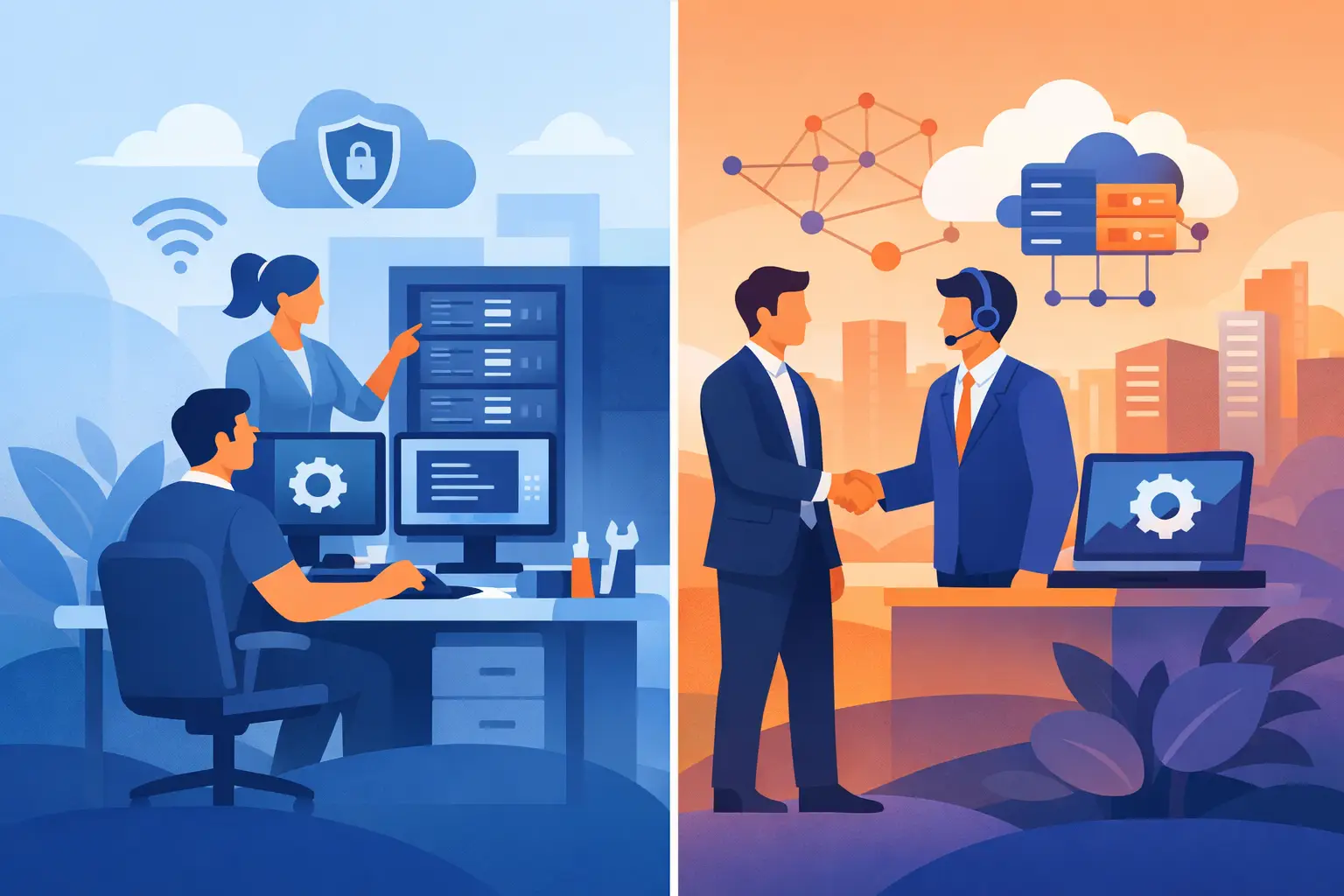
An in-house IT model means employees manage technology internally. Depending on the organization, that may be one IT manager, a small technical team, or a full department. They maintain systems, support users, coordinate vendors, address cybersecurity issues, and help leadership plan technology investments.
Managed IT services shift some or all of those responsibilities to an outside technology partner. The provider monitors and supports the environment under an ongoing agreement, often covering endpoints, networks, cloud platforms, backups, cybersecurity tools, help desk support, vendor management, and strategic planning.
The distinction matters because business technology has become more interconnected. A network issue can affect cloud applications, voice services, physical security cameras, remote access, and customer response times at once. When several vendors own separate pieces of the environment, identifying and resolving the issue can take longer than the business can afford.
A managed provider is not just an outsourced help desk. In a well-structured relationship, it serves as an accountable technology partner with defined service levels, documented processes, and a practical understanding of the systems your business relies on every day.
Where In-House IT Delivers Value
Internal IT is often the right choice for organizations with highly specialized applications, complex internal workflows, or large enough environments to justify dedicated roles. An on-site team understands the people, processes, and operational history of the business. That familiarity can be valuable when a technology issue has unusual context or requires immediate hands-on coordination.
Internal staff can also build deep knowledge of proprietary systems over time. A manufacturer with custom production software, for example, may need an IT professional who understands how network performance, equipment connectivity, and production schedules affect one another.
However, relying on a small internal team creates a coverage challenge. One or two capable employees cannot realistically be experts in cybersecurity, cloud architecture, networking, voice systems, compliance, backup recovery, vendor procurement, and end-user support at the same time. Vacation time, turnover, after-hours incidents, and competing project demands can leave critical work delayed.
The cost of an internal team is also more than salary. Recruiting, benefits, training, certifications, management time, tools, and emergency outside support all factor into the real investment. Businesses should evaluate whether their team has enough capacity to prevent issues, not only respond after they happen.
What Managed Services Changes
Managed services are designed to replace the reactive break-fix cycle with ongoing oversight. Rather than waiting for employees to report a problem, a provider uses monitoring and management tools to identify warning signs such as failing hardware, storage constraints, missed backups, unusual login activity, and network instability.
That proactive approach supports business continuity. A patching process, tested backup strategy, endpoint protection plan, and documented incident response procedure may not be visible when everything is working. They become essential when an employee clicks a malicious link, a device is lost, or a critical system goes offline.
Managed services also give businesses access to a broader bench of specialists. Instead of expecting one internal resource to solve every issue, organizations can draw on network engineers, security professionals, cloud experts, communications specialists, and project technicians as needed. This is especially useful during a major migration, office relocation, acquisition, or period of rapid hiring.
For many organizations, predictable monthly costs are another advantage. A managed agreement helps leaders budget for ongoing support while reducing surprise repair expenses. The value is not that every technology expense disappears. Hardware refreshes, licensing, and strategic projects still require planning. The difference is that those needs can be identified earlier and managed with a clearer roadmap.
Security and Risk Require More Than Coverage
Cybersecurity often changes the in house IT vs managed services conversation. Attackers do not limit their activity to large enterprises. Small and mid-sized businesses are frequently targeted because they may have fewer internal controls and limited security staff.
An internal IT person may be highly skilled, but security requires consistent attention. That includes vulnerability management, multifactor authentication, endpoint monitoring, email security, access controls, backup protection, user education, and response planning. Missing one control can create an opening that affects operations, finances, and customer trust.
A managed provider can help establish layered defenses and continuously review the environment for changes that introduce risk. Still, outsourcing does not remove leadership responsibility. Executives must set priorities, approve policies, and support employee accountability. Technology can reduce risk, but it cannot replace sound business practices.
Organizations in regulated industries may also need stronger documentation, access reporting, retention controls, and formal recovery procedures. In these cases, the right provider should be able to align technical operations with the organization’s compliance requirements rather than offering a generic package.
The Case for a Co-Managed Model
The choice does not have to be all or nothing. Many growing companies benefit from co-managed IT, where an internal technology leader works alongside a managed services partner.
This model lets internal staff focus on business-specific projects, application ownership, and direct coordination with departments. The managed provider handles routine support, monitoring, security operations, infrastructure maintenance, and escalation coverage. It can also provide additional capacity during projects or emergencies without forcing the company to hire several full-time specialists.
Co-managed IT works particularly well when an internal IT manager is stretched thin. Rather than replacing that person, a dependable partner gives them the tools, technical depth, and after-hours coverage needed to operate more strategically. The result is less time spent chasing tickets and more time improving systems that move the business forward.
How to Evaluate the Right Fit
Start with the operational consequences of technology failure. Ask how long your business can tolerate an internet outage, inaccessible files, compromised email, or a failed line-of-business application. Then consider whether your current model provides the monitoring, response time, recovery capability, and expertise required to limit that disruption.
Next, assess your internal capacity honestly. Is IT primarily reacting to user issues? Are updates, documentation, and security reviews happening on schedule? Does one person hold too much institutional knowledge? Are multiple vendors pointing to each other when an issue crosses systems? These are signs that the organization may need outside support or a stronger co-managed structure.
Finally, look beyond the monthly fee. Compare the total cost of staffing, tools, downtime, security exposure, emergency projects, and missed opportunities. A lower-cost option is not a better value if it leaves the business unable to recover quickly or scale reliably.
A strong managed services partner should take time to understand your business goals before recommending a model. At Plasma Networks, that means looking across infrastructure, security, connectivity, communications, and physical security so technology decisions support the entire operation rather than one isolated system.
The best choice is the one that gives your team confidence to operate without technology becoming a daily distraction. Whether you build internal capability, use managed services, or combine both, set clear ownership, measure performance, and choose a partner structure that protects the work your business depends on.


