
A missed customer call can become a missed order, an unresolved service issue, or a delayed decision. That is why the cloud phones vs on prem PBX decision deserves more attention than a simple feature comparison. Your phone system affects how reliably employees, customers, vendors, and remote teams can reach one another when business is moving quickly.
For many small and mid-sized organizations, cloud phones offer the most practical path forward. But an on-premises private branch exchange, or PBX, can still be the right fit when an organization has unusual control, connectivity, or compliance requirements. The better choice depends on how your business operates, how much internal IT capacity you have, and how much risk you are willing to manage yourself.
Cloud Phones vs On-Prem PBX: The Core Difference
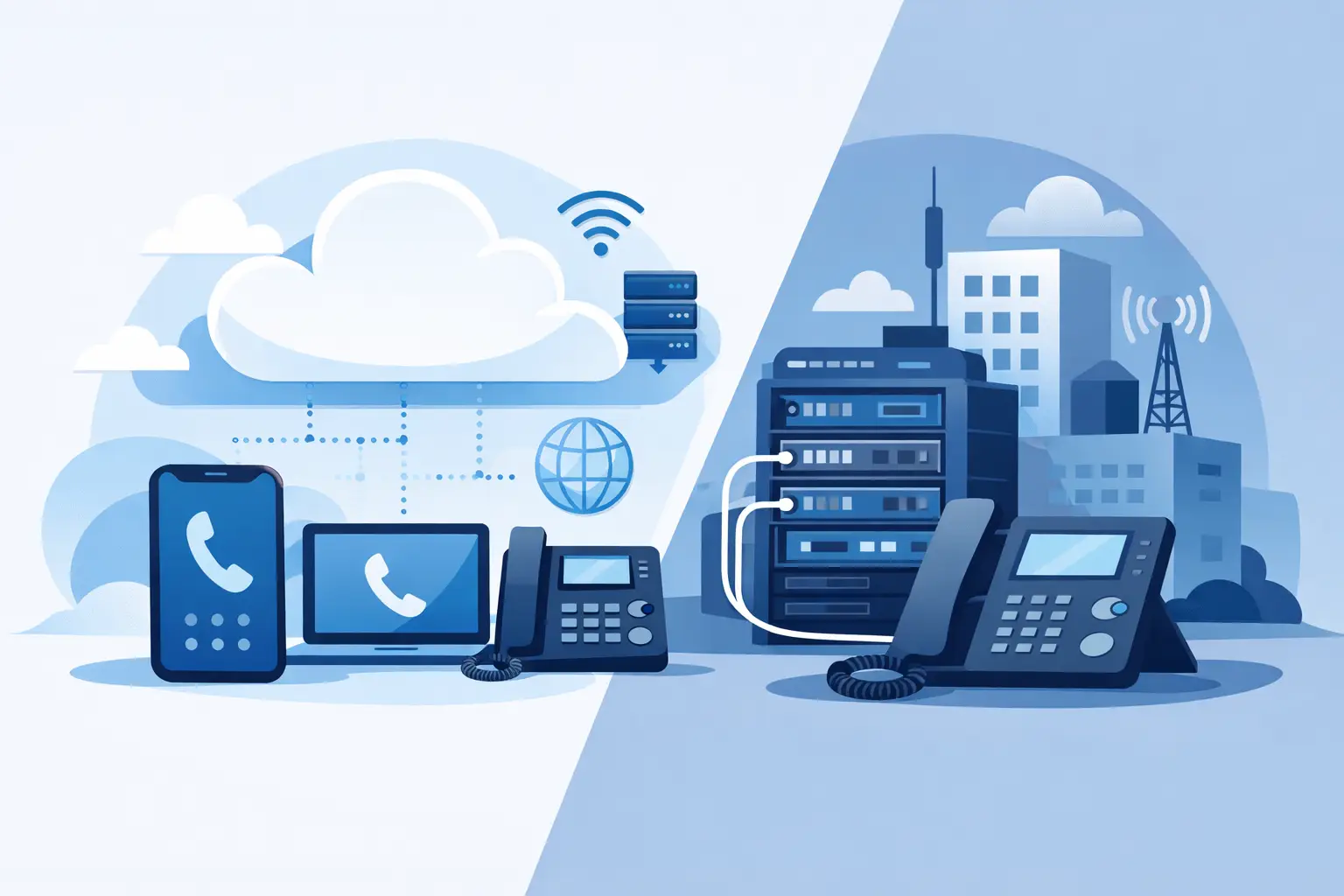
Cloud phone systems deliver calling services through an internet connection. The provider hosts and maintains the core phone platform in its data centers, while your team uses desk phones, mobile apps, softphones, or conference room devices at each location. Administration is generally handled through a web portal, and new users, call routing rules, and locations can be added without installing a new phone server in the office.
An on-prem PBX places the calling server and much of the supporting equipment at your facility. Your organization owns or leases the hardware, is responsible for its lifecycle, and typically relies on an internal IT team or service partner to maintain it. Traditional PBX systems may use local phone circuits, although many now connect to SIP trunking services for external calling.
The distinction is not just where the equipment sits. It determines who manages upgrades, who carries the burden of redundancy, how quickly you can scale, and what happens when an office loses power or internet service.
Cost: Capital Expense Versus Predictable Monthly Service
An on-prem PBX often requires a larger upfront investment. That can include the server, licensing, gateways, handsets, wiring, installation, backup power, support agreements, and replacement components. A business that already owns a capable system may see value in extending its useful life, especially when its calling needs are stable.
The long-term cost picture is more complicated. Hardware eventually reaches end of life. Manufacturer support changes. Security patches and platform upgrades can require professional services. If the system needs to grow from 40 users to 100, the business may need additional licensing, capacity, and equipment rather than simply adding seats.
Cloud phones generally shift spending to a monthly per-user model. That approach can be easier to budget and reduces the need for a major capital purchase. It also makes costs more transparent when staffing changes. You can add a user for a new hire or remove a license when a role is eliminated.
A monthly service is not automatically less expensive, particularly for organizations with a very large, steady user base. Still, the right comparison includes more than licensing. Factor in maintenance labor, downtime risk, support coverage, replacement hardware, carrier management, and the cost of an aging system that no longer supports how people work.
Reliability Depends on More Than the Platform
A common concern is that cloud calling fails when the internet fails. That concern is valid, but it is incomplete. Cloud phones depend on a well-designed network, sufficient bandwidth, quality-of-service configuration, reliable internet connectivity, and power at the office. If those foundations are weak, call quality and availability will be weak too.
A properly designed cloud environment can reduce the impact of a local outage. Calls can be forwarded automatically to mobile devices, another office, or a temporary answering destination. Employees can continue making and receiving calls through an app from another location with internet access. The core phone service remains available even if one office is offline.
An on-prem PBX may continue to support internal calling during certain external service outages, depending on its design. However, it remains vulnerable to a local hardware failure, building power loss, flood, fire, or equipment room issue unless the business invests in redundant systems and a separate recovery site. Those protections are possible, but they require planning and ongoing maintenance.
For either model, reliability starts with a business continuity plan. Identify critical call flows, provide battery backup where needed, document failover procedures, and test them. A phone system should not become a single point of failure simply because it was assumed to work.
Mobility and Growth Favor Cloud Phones
The modern workforce is rarely limited to one building. Employees may work from home, travel between facilities, handle calls after hours, or need to assist customers during an office closure. Cloud platforms are designed for this reality. A user can often keep one business number and extension across a desk phone, laptop, and mobile app.
That flexibility improves responsiveness without forcing employees to publish personal cell numbers. It also gives managers more control over voicemail, call queues, business hours, recordings, and routing rules. When a department expands or a new branch opens, the system can usually be extended without deploying another PBX server.
An on-premises system can support remote users, but the setup is often more complex. It may require virtual private network access, specialized configuration, remote licenses, session border controllers, or more hands-on troubleshooting. For a company with a small administrative team, that additional complexity can become a recurring burden.
Cloud phones are particularly effective for organizations growing through new locations, acquisitions, hybrid work, or seasonal staffing. The service can follow the employee rather than remain tied to a wiring closet.
Security and Control Require Clear Ownership
Some leaders assume an on-prem PBX is inherently more secure because it sits inside the building. Physical location alone does not make a system secure. Any internet-connected phone platform needs strong authentication, timely patching, restricted administrative access, fraud monitoring, network segmentation, and careful configuration.
With an on-prem system, your organization owns more of those responsibilities. That can be appropriate for a business with experienced IT staff, documented processes, and a specific requirement to control every layer of the environment. It can also create exposure if software updates are delayed or administrative credentials are not managed carefully.
Cloud providers typically operate dedicated infrastructure, maintain the platform, and deliver updates as part of the service. That reduces some operational workload, but the customer still has important responsibilities. User access, multi-factor authentication where available, call permissions, endpoint security, and network protection remain essential.
For regulated organizations, the right answer may depend on retention requirements, call recording rules, data residency, and how communications records must be protected. The question is not whether cloud or on-prem is universally better. It is whether the selected design meets the organization’s specific risk and compliance obligations.
When an On-Prem PBX Still Makes Sense
On-premises PBX systems remain a reasonable choice in certain environments. A facility with unreliable internet, highly specialized analog equipment, complex local paging, legacy integrations, or strict control requirements may benefit from keeping call processing on site. Manufacturing plants, healthcare facilities, campuses, and organizations with unusual operational workflows sometimes need a tailored hybrid design.
A hybrid approach can preserve essential on-site capabilities while using cloud services for remote users, overflow calls, or business continuity. This is often preferable to forcing a complete replacement before the organization is ready.
The key is to avoid treating existing equipment as a reason to postpone planning. A system can be functional while still creating increasing support risk. Review vendor support status, replacement parts availability, security patching, carrier dependencies, and recovery options before a failure makes the decision urgent.
How to Make the Right Phone System Decision
Start with the business outcome, not the handset. Consider how calls move through your organization, where employees work, what happens during an outage, and which departments cannot afford to be unreachable. Evaluate current internet capacity and network health before moving voice traffic to the cloud.
Then compare the full operating cost of both approaches over several years. Include implementation, support, carrier charges, hardware replacement, licensing, internal administration, and the potential impact of downtime. A lower initial price can be expensive if it leaves the business without dependable support or a recovery plan.
It also helps to involve the teams that answer phones every day. Reception, customer service, sales, operations, and IT often see different problems. Their input can reveal whether the priority is easier call transfers, better after-hours routing, remote access, reporting, integration, or simply more consistent call quality.
Plasma Networks helps businesses assess voice systems as part of the wider technology environment, including network readiness, cybersecurity, connectivity, and continuity planning. That broader view matters because a reliable phone system depends on more than the phones themselves.
The best choice is the one that keeps your people reachable when conditions are not ideal. Build the decision around your real call flows, your growth plans, and the level of support your team can sustain. A phone system should give your business a dependable way to respond, not another critical system to worry about.


