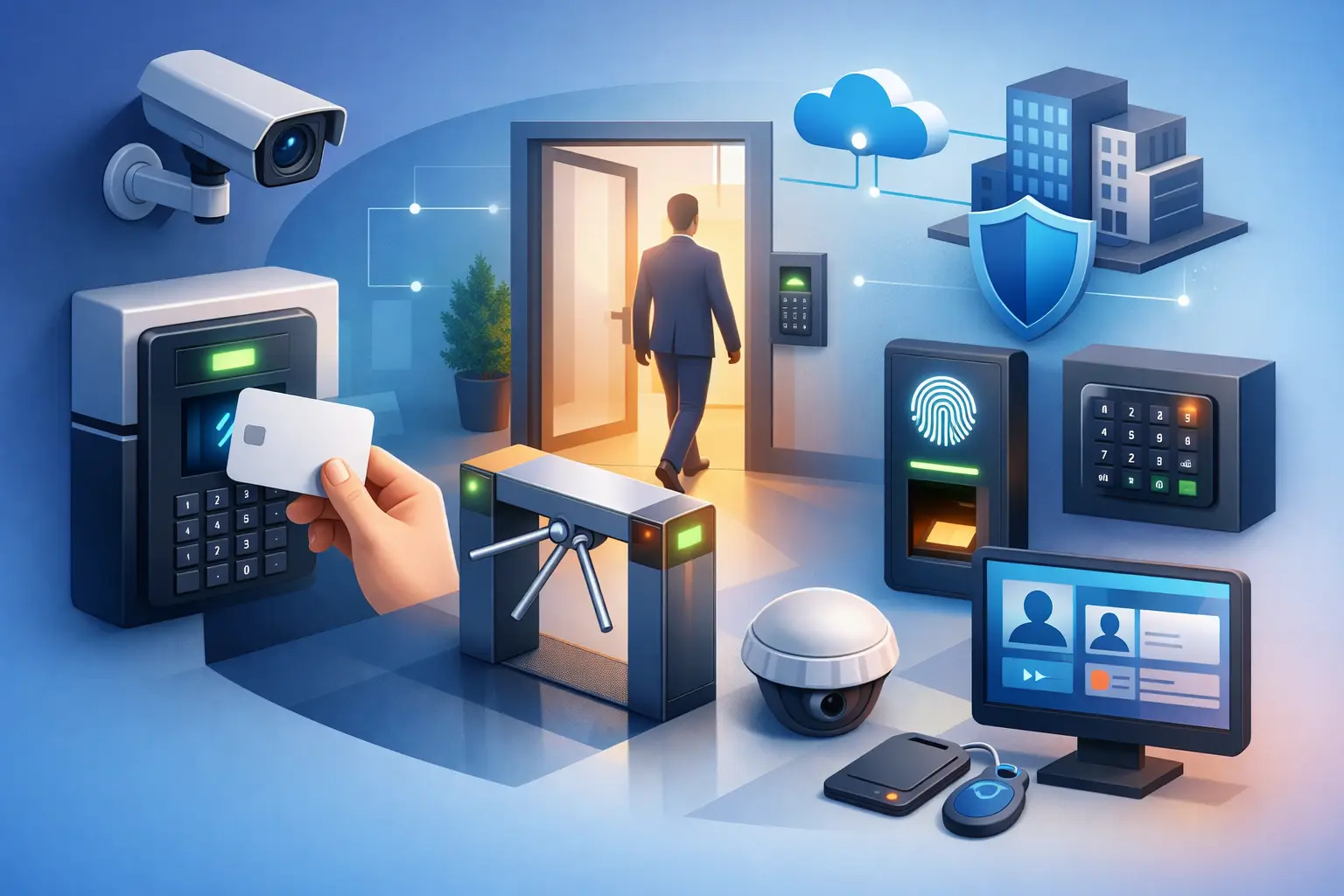
A lost key is rarely just a lost key. It can mean rekeying doors, tracking down old copies, worrying about after-hours access, and wondering who can still enter your building. That is why access control systems for businesses have become a practical security investment, not just a facility upgrade. They give organizations tighter control over who enters, when they enter, and what parts of the building they can reach.
For many small and mid-sized companies, physical security still depends on a patchwork of locks, alarm codes, and manual processes. That may work in a single office with a stable team. It starts to break down when you add employee turnover, multiple entrances, vendor access, shared spaces, compliance requirements, or more than one location. At that point, the question is no longer whether access needs to be managed more carefully. It is whether your current system can support the way your business actually operates.
What access control systems for businesses actually do
An access control system replaces or supplements traditional keys with credential-based entry. Instead of handing out physical keys and hoping they stay secure, businesses can issue access through key cards, fobs, mobile credentials, PINs, or biometric verification. Permissions can be assigned by user, role, department, schedule, or location.
That sounds straightforward, but the real value is operational control. If an employee leaves, access can be removed without replacing hardware across the building. If a delivery vendor only needs entry on Tuesday mornings, their access can be limited to that time window. If a manager needs to review who entered a restricted area, the system can provide an event log instead of guesswork.
This is where access control moves beyond door security. It supports accountability, policy enforcement, and day-to-day decision-making. Businesses are not only protecting assets. They are reducing uncertainty.
Why businesses outgrow traditional locks
Mechanical locks still have a place, but they offer very little flexibility. Once a key is copied, shared, or lost, control is compromised. There is no audit trail. There is no remote change. There is no simple way to allow temporary access without creating ongoing risk.
That creates problems in real business scenarios. A healthcare office may need to restrict access to records storage. A warehouse may need separate permissions for shipping, inventory, and management. A professional services firm may need after-hours access for a cleaning crew without giving unrestricted building entry. Traditional locks can handle simple entry. They struggle with layered access needs.
There is also a cost issue that often gets overlooked. Businesses sometimes delay access control because they view it as a capital expense. But the hidden cost of manual key management, lock changes, security incidents, and administrative overhead adds up quickly. In many cases, the expense is already there. It is just spread across avoidable problems.
The business case for modern access control
The strongest case for modern systems is not convenience alone. It is risk reduction paired with better operational discipline.
A well-designed system helps businesses manage access in a way that matches real responsibilities. Employees get entry only where needed. Sensitive areas stay limited to approved personnel. Temporary users can be added and removed without changing the entire security setup. Managers can respond faster when an issue comes up.
There is also a broader continuity benefit. Security incidents do not only create safety concerns. They can interrupt operations, trigger compliance questions, and consume internal time. Access control gives businesses a cleaner process for preventing avoidable exposure.
For organizations already investing in cybersecurity, this should feel familiar. You would not give every employee full administrative rights to your network. Physical spaces deserve the same level of structured access.
Choosing the right access control system for your business
Not every business needs the same architecture, and that is where many buying decisions go wrong. Some companies are sold on features they will never use. Others end up with a system that cannot scale when they add staff or space.
The right fit depends on a few practical questions. How many doors need to be secured today, and how many may need to be added later? Do you need one central location or support across multiple sites? Are there compliance considerations around visitor logs or restricted areas? Who will manage the system internally, and how much time can they realistically devote to it?
Cloud-managed access control is often a strong option for growing businesses because it simplifies administration and supports remote management. That can be useful for office managers, IT leaders, or multi-site operators who need visibility without being physically present. On-premises systems may still make sense in environments with specific regulatory or network requirements. The better choice depends on the business, not the trend.
Credential type matters too. Cards and fobs remain common because they are simple and familiar. Mobile credentials reduce the need to distribute physical items and can be easier to manage at scale. Biometric readers can strengthen security in high-sensitivity areas, but they are not necessary for every door and may introduce privacy or workflow concerns. Strong security comes from the right mix of controls, not from using the most advanced option available.
Integration matters more than many buyers expect
Access control is more effective when it is connected to the rest of your technology and security environment. A standalone door system can manage entry. An integrated system can support a more complete response.
For example, pairing access control with video surveillance helps verify events instead of relying on access logs alone. Integrating with intrusion detection can improve after-hours alerts. Connecting user management to HR or IT workflows can streamline onboarding and offboarding, which reduces the risk of old credentials remaining active.
This is especially important for businesses trying to avoid fragmented vendors and overlapping systems. Physical security, network security, and communications infrastructure often intersect more than expected. A door reader may rely on network connectivity. Cloud-based administration may depend on stable internet performance. Alerts may need to route through broader communications tools. When those pieces are handled in isolation, gaps emerge.
That is why implementation should be treated as part of your broader technology strategy, not just a door hardware project.
Common mistakes with access control systems for businesses
One of the most common mistakes is designing around the building instead of the business. It is easy to focus on entrances, locks, and hardware counts. It is more valuable to start with workflows, user roles, risk points, and operational habits. Security works better when it reflects how people actually move through the space.
Another mistake is underestimating administration. Access control is not a one-time install. Employees join, change roles, transfer locations, and leave. Vendors come and go. Schedules shift. If the system is difficult to manage, permissions become outdated, and the benefits start to erode.
There is also a tendency to overcomplicate the rollout. Not every door needs the same level of security on day one. Many businesses benefit from a phased approach that secures primary entry points, server rooms, inventory areas, or executive spaces first, then expands as needs evolve. That approach can improve adoption and keep spending aligned with risk.
What implementation should look like
A solid deployment starts with assessment, not equipment. You need a clear view of entrances, traffic patterns, restricted areas, staffing structure, and operational risks. From there, the system design should account for current requirements and likely growth.
Installation quality matters just as much as product selection. Readers, controllers, door hardware, power, cabling, and network configuration all need to work together reliably. If one weak point causes lockouts, false alarms, or inconsistent reporting, confidence in the system drops fast.
Training is another critical step. The people managing access need to know how to add users, remove credentials, set schedules, and review activity. Employees also need simple guidance on how to use the system correctly. Good security depends on clarity, not assumptions.
For many organizations, ongoing support is where long-term value shows up. Systems need updates, adjustments, and occasional troubleshooting. As the business changes, access policies should change with it. That is easier when you have a technology partner that understands both physical security and the supporting IT environment.
A dependable access control system should make your business more secure without making daily operations harder. If it is designed well, it gives leaders more visibility, reduces avoidable risk, and supports the kind of steady control that growing organizations need. The best time to review your access strategy is before a security gap forces the conversation.