When a business starts missing tickets, struggling with security, or relying too heavily on one internal IT person, the question usually comes fast: should we add outside help or hand IT off entirely? That is where co managed IT vs outsourced IT becomes a practical business decision, not just an IT one. The right model affects uptime, accountability, hiring pressure, cybersecurity exposure, and how well your systems keep up with growth.
For many small and mid-sized organizations, the answer is not as simple as choosing the cheaper option. It depends on what your internal team can realistically own, how much strategic guidance you need, and how much risk your business can tolerate when systems go down.
What co managed IT vs outsourced IT actually means
Co-managed IT is a shared-support model. Your internal IT staff keeps ownership of some functions, while an external provider fills gaps, expands capacity, or adds specialized expertise. In practice, that might mean your team handles day-to-day user support while the provider manages cybersecurity, backup, cloud infrastructure, or after-hours coverage.
Outsourced IT is different. In that model, an external provider becomes the primary IT function for your business. Instead of supplementing an internal team, they take responsibility for the help desk, infrastructure support, vendor coordination, security management, strategic planning, and often procurement and project delivery as well.
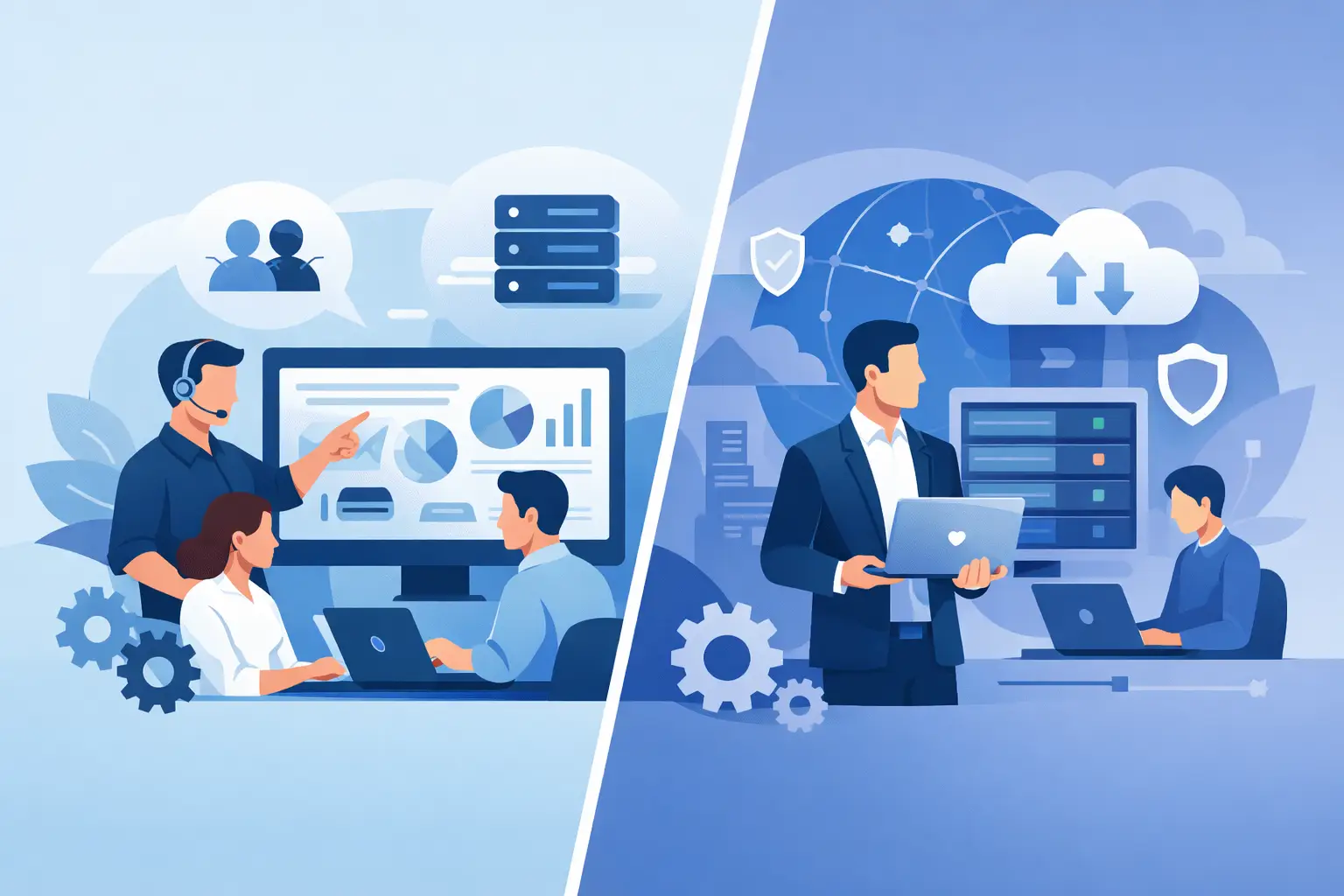
The distinction matters because these models solve different problems. Co-managed IT supports internal teams that need reinforcement. Outsourced IT supports businesses that need a complete IT department without building one in-house.
When co-managed IT makes more sense
Co-managed IT is often the better fit when you already have capable people internally but they are stretched too thin. This is common in growing companies where one or two IT employees are carrying a broad workload – user support, network issues, Microsoft 365, security alerts, hardware refreshes, and project work all at once.
In that environment, adding a co-managed partner can improve performance without disrupting internal leadership. Your in-house team keeps visibility and control, while the provider adds tools, depth, and coverage. That can be especially valuable for cybersecurity, compliance preparation, cloud migrations, backup oversight, and escalation support for problems that exceed internal bandwidth.
There is also a people factor. Some companies want to retain an internal IT lead because that person understands the business, the users, and the politics behind technology decisions. Co-managed IT preserves that advantage while reducing burnout and single-point-of-failure risk.
This model also works well for organizations with seasonal demand, multiple locations, or active expansion plans. Instead of hiring several specialists, you can extend the team with a partner that brings broader experience across infrastructure, security, connectivity, and communications.
When outsourced IT is the better move
Outsourced IT is usually the stronger choice when there is no true internal IT department, or when the current setup is too reactive to support the business. A lot of companies reach this point after years of patchwork support – a helpful office manager, a part-time consultant, a software vendor handling only their own product, and no one fully accountable for the environment.
That arrangement tends to hold until something serious happens. A ransomware event, server failure, internet outage, compliance issue, or prolonged downtime exposes how fragmented support really is.
An outsourced IT model creates a more complete operating structure. Instead of juggling vendors and internal guesswork, the business gets a defined support desk, monitoring, patching, asset visibility, documented processes, security oversight, and strategic planning. It gives leadership one accountable partner rather than a collection of disconnected resources.
For many small and mid-sized businesses, this is also the most cost-effective path. Hiring an internal team with expertise in networking, security, cloud systems, voice, procurement, and project delivery is expensive. Even if you can afford it, recruiting and retaining those skills is difficult. Outsourced IT gives access to that range of support without building the entire bench internally.
The biggest differences in day-to-day operations
The practical difference between co-managed and outsourced IT shows up in ownership.
With co-managed IT, responsibilities are split. That means roles must be clearly defined. Who owns endpoint security? Who handles after-hours emergencies? Who talks to your ISP during an outage? Who approves access changes? If those lines are vague, response slows down and frustration grows.
With outsourced IT, ownership is simpler because the provider manages most or all of the operational stack. That often leads to faster execution and fewer handoff issues, but it also means your business is trusting an external partner with more control over critical systems.
Neither model is automatically better. Co-managed IT offers flexibility and preserves internal involvement. Outsourced IT offers consistency and consolidated accountability. The better fit depends on whether your business needs added capacity or full operational ownership.
Cost is not just about the monthly invoice
Many decision-makers compare co managed IT vs outsourced IT by looking at contract cost alone. That is understandable, but it misses the larger business picture.
Co-managed IT can look less expensive because you are not outsourcing everything. But you are still carrying internal payroll, training, management overhead, and the risk that key knowledge sits with one or two employees. If those employees leave, your cost and disruption can rise quickly.
Outsourced IT often creates more predictable budgeting because support, monitoring, maintenance, and strategic guidance are rolled into a structured service model. That predictability matters for businesses trying to control operating costs and avoid surprise project spending.
The real cost question is whether your current support model prevents downtime, limits security incidents, and keeps staff productive. If the answer is no, a lower monthly number can become the more expensive choice.
Security and compliance considerations
Security is one of the clearest decision points.
If your internal team is strong in user support and infrastructure but lacks cybersecurity depth, co-managed IT can be a smart way to close that gap. A provider can take on managed detection, endpoint protection, vulnerability management, email security, incident response planning, and policy support while your team remains the internal face of IT.
If your business has little internal security capability at all, outsourced IT is often the safer route. Security requires consistent monitoring, disciplined patching, documented procedures, backup validation, and fast incident response. Those functions are hard to maintain without dedicated processes and specialized tools.
This matters even more in regulated or operationally sensitive environments. If you face client security requirements, cyber insurance pressure, or formal compliance obligations, support quality is not just about convenience. It affects risk exposure, insurability, and business continuity.
How to choose the right model
The best decision usually comes from answering a few operational questions honestly.
If you already have an internal IT leader your business trusts, and that person mainly needs stronger tools, deeper expertise, or extra hands, co-managed IT is often the right fit. It strengthens what is already working.
If your internal support is informal, inconsistent, or too dependent on one person, outsourced IT is usually the better structure. It gives your business a more stable foundation and clearer accountability.
It also helps to look at future state, not just current pain. If you plan to add locations, migrate systems, tighten security, or standardize processes, choose the model that can support that growth without constant restructuring.
For some organizations, the answer changes over time. A company may start with outsourced IT, then move to co-managed support later after hiring an internal IT manager. Others go the opposite direction after realizing the internal team is spending too much time on tickets and not enough on strategy. A good technology partner should be able to support either path without forcing a one-size-fits-all approach.
What a strong provider should bring to either model
Whether you choose co-managed or outsourced IT, the provider should improve control, not add confusion. That means clear service boundaries, documented escalation paths, proactive monitoring, security discipline, responsive support, and the ability to coordinate across infrastructure, connectivity, cloud platforms, and communications.
For businesses that want one accountable partner across the broader technology environment, that breadth matters. It reduces vendor overlap and helps keep decisions aligned around uptime, protection, and long-term performance. That is part of what businesses look for in a partner like Plasma Networks – not just technical support, but operational clarity.
The right choice is the one that gives your business dependable coverage, stronger security, and room to grow without putting more strain on your team. If your current IT model leaves too much to chance, that is usually the clearest sign it is time to change it.